

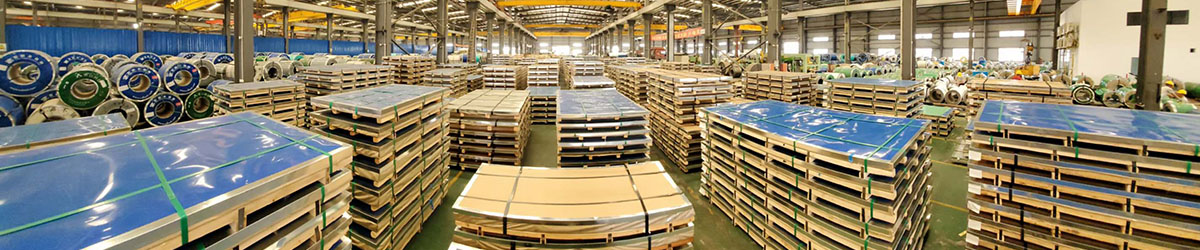
In the steel manufacturing industry, galvanized coils play a vital role across various sectors due to their superior durability and corrosion resistance. We specialize in producing high-quality galvanized coils, including hot-dip galvanized coils and ordinary steel coils.
The galvanized coil production process uses cold-rolled or hot-rolled steel coils as the base material and involves multiple processes such as pretreatment, galvanizing, and post-treatment to form a uniform zinc layer on the steel strip surface. The mainstream technologies can be divided into two main categories: hot-dip galvanizing and electro-galvanizing.
Core Mainstream Process: Continuous Hot-Dip Galvanizing
This is currently the most widely used galvanized coil production method in the industrial field.
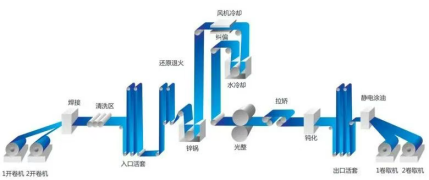
1. Substrate Pretreatment: First, the steel coil is uncoiled and welded together. Then, it undergoes a complete process of alkaline degreasing, hydrochloric acid pickling, three-stage water washing, and hot air drying to thoroughly remove grease, scale, and other impurities from the steel strip surface, achieving a surface cleanliness standard of Sa2.5, thus preventing subsequent coating peeling defects.
2. Reduction Annealing: The cleaned steel strip is fed into a continuous annealing furnace. First, it is heated to approximately 450℃ in an oxidation furnace to burn off residual rolling oil. Then, it is heated to 700-800℃ in a reduction furnace to complete recrystallization annealing. Hydrogen reduction is used to remove the surface oxide film, ensuring the steel strip’s temperature is stably controlled at around 480℃ before entering the zinc bath. Air is completely isolated throughout the process to ensure coating adhesion.
3. Zinc Bath Dip Coating: The pre-treated steel strip is immersed in molten zinc at **455-465℃** to achieve metallurgical bonding. A purge pressure of 20-60 kPa, controlled by an air knife system, is used to precisely adjust the zinc layer thickness, resulting in a uniform coating structure.
4. Post-treatment Process: The dip-coated steel strip undergoes forced air cooling, stretching and straightening, and precision shearing to obtain a finished product with a flatness ≤3I unit. Subsequent treatments such as passivation, oiling, and fingerprint-resistant coatings can be added as needed to further improve the product’s weather resistance.
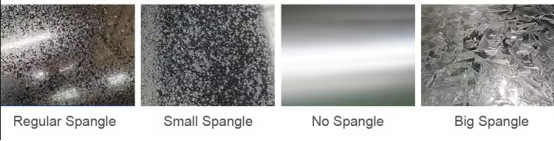
Zinc Flower Appearance.
The zinc flower appearance of galvanized coils refers to the unique snowflake-like or hexagonal star-shaped surface texture formed naturally during the cooling and solidification of the zinc layer in the hot-dip galvanizing process. It is one of the most recognizable appearance features of the hot-dip galvanizing process.
The zinc flower appearance of galvanized coils can be clearly divided into four categories:
* Normal Zinc Flower (Large Zinc Flower): The surface is covered with clearly visible hexagonal zinc flower grains. The diameter of a single zinc flower can reach 5-20mm. The overall appearance is bright and eye-catching, with a strong three-dimensional effect. This is the most classic appearance of traditional hot-dip galvanized coils.
* Small Zinc Flower: Achieved by accelerating the cooling rate and increasing the number of crystal nuclei. The diameter of the zinc flower is generally ≤3mm. The texture is fine and uniform to the naked eye, with almost no abrupt large grains visible. The smoothness of the appearance is far superior to that of large zinc flower products.
* No Zinc Flower (Zero Zinc Flower): A special process completely inhibits the growth of zinc grains. The surface is smooth and uniform, with no visible crystal patterns. The appearance is close to that of mirror-finish cold-rolled sheet, with no trace of zinc flower texture.
*Smooth finish: After galvanizing, the steel plate is rolled on a smooth finishing machine to completely flatten the original zinc spangles, resulting in a smooth and bright surface. At the same time, it imparts controllable micro-roughness to the steel plate, completely eliminating the appearance characteristics of zinc spangles.
Application Scenarios of Galvanized Steel Coil
1. Construction Industry:
* Roofing and Walls: In industrial plants, large warehouses, and other buildings, galvanized steel coils are used for roofing and walls, requiring good corrosion resistance and formability.
* Doors, Windows, and Decoration: When used for door and window frames and interior decoration, high surface quality and processing precision are required.
2. Home Appliance Industry:
* Outer Shell Manufacturing: Outer shells for home appliances such as refrigerators, washing machines, and air conditioners require galvanized steel coils with good stamping performance and surface quality.
* Internal Structural Components: Internal structural components such as brackets and partitions in home appliances require materials with high strength and processing performance.
3. Automotive Industry:
* Body Panels: For components such as car fenders, door panels, and side panels, materials need to possess both sufficient strength and good stamping performance and corrosion resistance.
* Chassis Components: The chassis operates in harsh driving environments and requires extremely high corrosion resistance.
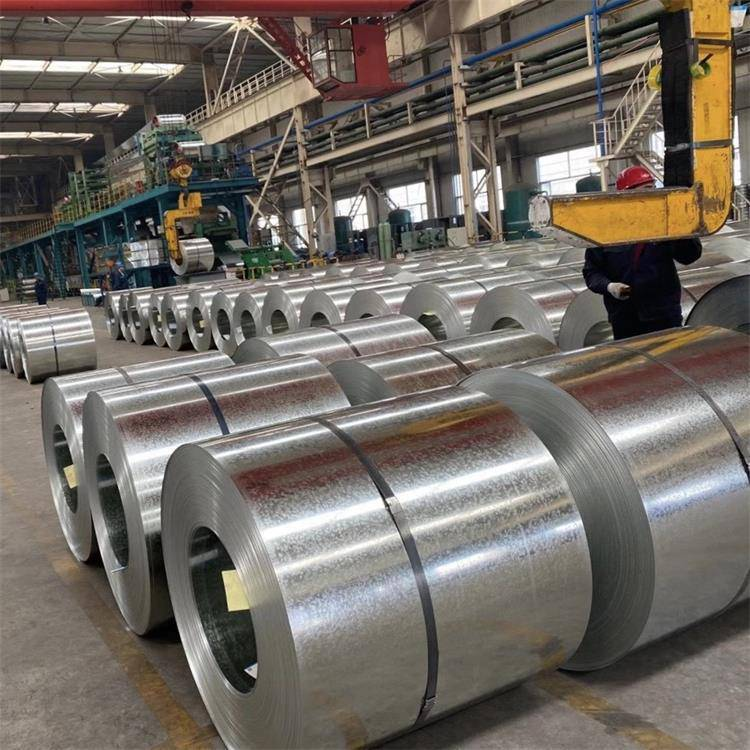
Galvanized coils, including hot-dip galvanized coils and steel coils, are indispensable components across various industries due to their superior corrosion resistance and durability. The manufacturing process, the materials used, and the unique characteristics of zinc spangle contribute to the overall quality of these products. With their wide range of applications and adherence to stringent standards, galvanized coils remain the preferred choice for many industries.
Post time: Jun-26-2026


