

2026-2030 Steel Roofing Market Report: Western Europe Leads the Market in 2025; Asia Pacific Expected to Become the Future Growth Leader. Driven by increasing demand for sustainable and durable roofing solutions, rising renovation activity, and advanced coating technologies, the steel roofing market is poised for significant growth.
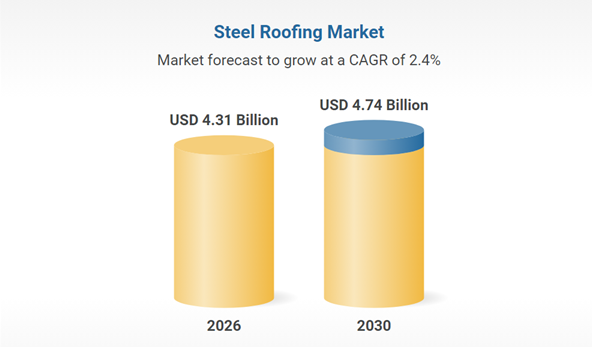
The steel roofing market is showing steady growth, projected to grow from US$4.2 billion in 2025 to US$4.31 billion in 2026, representing a compound annual growth rate (CAGR) of 2.6%. Key drivers of this growth include continued demand for traditional galvanized materials, increased construction activity, and cost-effective production processes. As the market develops, the demand for durable and long-lasting roofing solutions is also increasing.
I. Demand Side: Traditional Sectors Stabilize, Emerging Scenarios Experience Explosion
Traditional Sectors: Construction and Automobiles Remain Core Support
Construction Sector
Saudi Arabia’s “Vision 2030″ has driven 4.13 trillion riyals of infrastructure investment, with the Saudi construction market reaching $74.1 billion by 2025. It is projected to grow at an annual rate of 5.4% over the next five years, leading to a continued increase in demand for coated steel sheets as exterior wall decoration materials.
Automotive Sector
Global production of new energy vehicles is expected to exceed 20 million units by 2025, driving a surge in demand for high-strength galvanized steel sheets. For example, high-strength galvanized steel sheets with a strength of 600MPa and above are already being used in large quantities for battery pack casings, and 1180MPa-grade duplex steel has achieved a 20% weight reduction in automobiles.
Emerging Sectors: Photovoltaics and Green Buildings Become New Growth Drivers
New photovoltaic installations are driving demand for zinc-aluminum-magnesium (ZM) coated support structures. Coated steel sheets with a salt spray test rating of 2000 hours have become the preferred choice, with demand increasing by 200% year-on-year in 2023. Green building is driving the application of corrosion-resistant galvanized steel sheets in steel-structured residential buildings, with the proportion of steel-structured residential buildings in the Yangtze River Delta region expected to increase to 25% by 2025.
II. Technology: Green and Intelligent Manufacturing Drives Industrial Upgrading
Green Processes Replace Traditional Technologies
The penetration rate of chromium-free passivation technology will reach 65% by 2025, replacing hexavalent chromium to meet the EU RoHS directive; zinc-aluminum-magnesium coatings reduce zinc layer thickness by 30% and double lifespan.
A closed-loop waste acid regeneration system achieves 100% reuse of pickling solution, reducing environmental costs per ton of steel by 80 yuan. Leading enterprises such as Baosteel’s Zhanjiang base have seen a 30% reduction in VOCs emissions compared to 2020.
Intelligent Production Improves Efficiency
AI vision systems monitor coating uniformity in real time, achieving a defect identification accuracy rate of 99.2%; digital twin factories predict zinc pot slagging 48 hours in advance, reducing downtime losses. After application at a Baowu base, energy consumption per ton of steel decreased by 12%, and zinc consumption decreased by 4.7%.
III. Supply Chain: China Dominates Exports, Regionalization Accelerates
China’s Export Advantage Continues, but Faces Transformation Pressure
In 2025, China’s coated steel sheet exports exceeded 21 million tons, with Southeast Asia and the Middle East as core markets. Saudi Arabia’s imports reached 677,000 tons (a year-on-year increase of 44.82%).
The average export price was under pressure, falling to $629.49/ton in November 2025 (an 80% decrease from the beginning of 2023), forcing companies to shift from “price competition” to “value competition.”
Regionalized Capacity Layout Copes with Trade Barriers
The EU’s CBAM carbon tariff may increase export costs by 8%-12%, prompting Chinese companies to accelerate factory construction in Southeast Asia and the Middle East (such as Baosteel’s Malaysian production line), forming a “China R&D + overseas manufacturing” model.
New galvanizing capacity in emerging markets such as India and Turkey may impact China’s export share. Companies need to consolidate their high-end market share through technological upgrades (such as ultra-high strength galvanized steel sheets).
Post time: Mar-30-2026


