

Welcome to the wonderful world of color-coated corrugated sheets! If you’re still struggling to choose between hot-dip galvanized (PPGI), aluminized zinc (PPGL), or premium zinc-aluminum-magnesium alloy color-coated corrugated sheets, you’re not alone. Let’s delve into the details of these materials to help you make the best choice for your roofing needs, all while keeping things light and fun!
First, let’s talk about corrosion resistance and lifespan. If you live in a coastal area where seawater erosion is the norm, you might want to avoid galvanized steel sheet (PPGI). It’s like your friend who’s not suited to the beach—it works inland, but not so well along the coast. On the other hand, galvanized aluminum-magnesium alloy sheet (PPGL) and galvanized aluminum-magnesium alloy sheet are like corrosion-resistant superheroes. They can withstand the harshest environments, making them ideal for coastal areas and areas with chemicals. So, if you want your roof to last longer than your last relationship, choose these materials!
Now, let’s talk about coatings. There are four main types: PE, HDP, SMP, and PVDF. PVDF is the best in terms of weather resistance, but it’s also quite expensive. HDP is close behind and is generally more suitable for outdoor roofs, offering better value. If you’re considering using PE coatings on walls, think twice! They’re better suited for roofs, and their durability on vertical surfaces may be poor.
Regarding thickness, you need to choose the appropriate color-coated corrugated board (thickness range from 0.3 mm to 1.2 mm) based on the actual application scenario. If the purlin spacing is 1.2 meters, 0.4 mm corrugated board is sufficient. If the spacing is 1.5 meters, you need to increase it to 0.5 mm; if the spacing reaches 2.0 meters, you can choose 0.6 mm or even 0.8 mm. The key is to find the optimal balance between strength and flexibility!
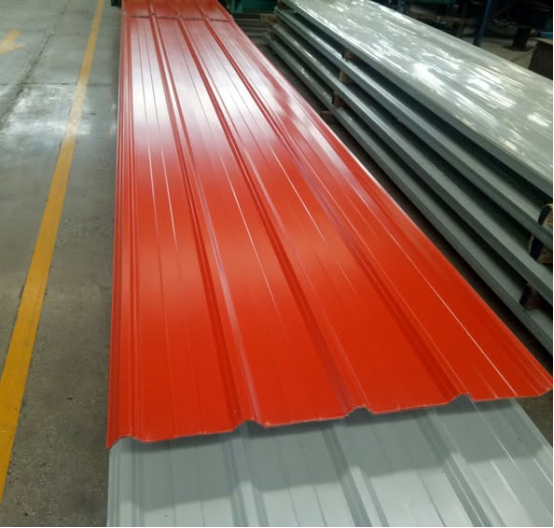
Now, let’s talk about the types of roof tiles. There are several types, including YX35-125-750, YX25-210-840, and YX15-225-900. If you’re planning to build a large-span roof, YX25-210-840 is your best choice. It’s like a reliable friend, always there when you need it. The other types of tiles are also good, but their load-bearing capacity may not be as high as YX25-210-840.
Finally, let’s address a long-standing debate: concealed snap-on roofing tiles versus overlapping colored-coated roofing tiles. Concealed snap-on tiles are like the introverts of the roofing world—ideal for typhoon-prone areas because they minimize leaks, but installation costs can be slightly higher. Overlapping tiles are more economical, but may not be as durable as concealed snap-on tiles in extreme weather conditions.
In short, whether you’re choosing between polycarbonate shingles (PPGI), galvanized aluminum-magnesium shingles (PPGL), or other types of galvanized aluminum-magnesium shingles, or if you’re struggling with coating and thickness considerations, Jindalai Steel Group Co., Ltd. can provide you with comprehensive support. With the right information and a touch of humor, you can make the best choice for your roofing needs. So, boldly explore the world of polycarbonate shingles! Your roof will thank you.
Post time: Feb-01-2026


