

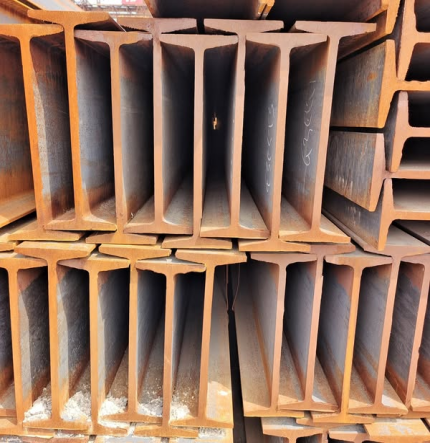
Welcome to the world of I-beams, where strength and aesthetics are perfectly combined, bringing a qualitative leap to your construction projects! If you’re still struggling to choose between Q235B and Q355B I-beams, or if you simply want to know what I25 is, then you’ve come to the right place. Let’s delve into all aspects of I-beams together. This episode is presented to you by Jindalai Steel Group Co., Ltd.
Q235B vs. Q355B: Beam Wars
First, let’s talk about a heavyweight showdown: Q235B and Q355B I-beams. You might ask, what’s the difference? Q235B is a classic carbon structural steel I-beam, ideal for general construction applications. It’s like a reliable friend, always there on time. Q355B, on the other hand, is a low-alloy, high-strength I-beam, meaning it can withstand greater weight and stress. You can think of it as the fitness enthusiast of the I-beam world. If you’re building frames or bridges, Q355B is ideal in terms of load-bearing capacity and strength.
Choose the appropriate I-beam size: I10 to I63
Now, let’s talk about sizes. They come in sizes from I10 to I63, but how do you choose? I25, I32, and I40 are like the “Goldilocks” of I-beams—each just right for different spans and load-bearing scenarios. I25 is perfect for small projects, while I40 can handle larger spans. Remember, beam size is directly related to its span and load-bearing capacity. So, my friend, choose carefully!
What are the differences between standard, lightweight, and wide-flange I-beams?
In terms of application scenarios, standard I-beams are widely used, lightweight I-beams are suitable for users who want to reduce weight without sacrificing strength, while wide-flange I-beams are heavy-duty steel beams for large-span buildings. If you are working in a confined space, lightweight I-beams are the best choice. Of course, for large, ambitious projects, wide-flange I-beams are often indispensable.
Weathering Steel I-Beams: A Powerful Tool Against Corrosion
Now, let’s delve into the technical details. How much better is the corrosion resistance of weathering steel I-beams than that of ordinary carbon steel I-beams? Much better! Weathering steel is specifically designed to withstand all kinds of harsh weather and is an essential material for outdoor projects such as ports and bridges. If your construction will withstand the test of nature, then don’t skimp on the selection of weathering steel.
Stainless Steel I-Beams: A High-End Choice
For certain special environments, stainless steel I-beams (304/316L) are your best choice. They are ideal for corrosive environments such as chemical plants. However, please note that they can be quite expensive. Q355B is a more economical option, but if you need even stronger corrosion resistance, stainless steel is definitely worth your investment.
Hot-rolled I-beams vs. welded I-beams: A battle of strength
Are there differences in strength and service life between hot-rolled I-beams and welded I-beams? Absolutely! Hot-rolled I-beams are generally stronger, but welded I-beams can be customized to larger diameters or special specifications. Therefore, if you need large-sized I-beams, welded I-beams may be a better choice.
Length matters: Custom length vs. standard length
Finally, let’s talk about length. Whether you need 6 meters, 9 meters, or 12 meters, the length of the I-beam will affect its load-bearing capacity. While custom lengths such as 3 meters or 15 meters can be made, transportation costs may increase significantly, so please be prepared.
Alright, that’s it! Whether you’re a seasoned professional or a newcomer to the construction industry, understanding I-beams is crucial for your project. With the right knowledge, plus the assistance of Jindalai Steel Group Co., Ltd., you’ll soon be building like a champion! Best wishes for your construction!
Post time: Jan-29-2026


