

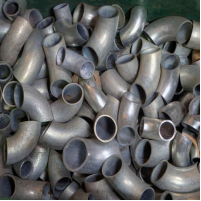
Elbows are key connecting fittings in piping systems used to change the direction of pipes. They are widely used in plumbing installations, petrochemicals, power generation, construction, and municipal engineering. As one of the largest fittings in piping systems (approximately 80%), their core function is to connect two pipes of the same or different nominal diameters, allowing the pipeline to turn at a specific angle.
Types of Elbow Fittings.
Elbows can be classified according to their radius of curvature into long-radius elbows and short-radius elbows.
Long-radius elbows: Their radius of curvature is equal to 1.5 times the outer diameter of the pipe, i.e., R=1.5D.
Short-radius elbows: Their radius of curvature is equal to the outer diameter of the pipe, i.e., R=D.
According to pressure ratings, there are approximately seventeen types, consistent with American pipe standards: Sch5s, Sch10s, Sch10, Sch20, Sch30, Sch40s, STD, Sch40, Sch60, Sch80s, XS; Sch0, Sch100, Sch120, Sch140, Sch160, XXS. STD and XS are the most commonly used.
According to the elbow angle, the most common are 45° elbows and 90° elbows.
The 90° elbow is designed to change the direction of fluid flow at a right angle, making it ideal for applications with limited space and requiring sharp turns.
The 45° elbow provides a smoother turn, helping to reduce turbulence and pressure loss in the system.
Materials used in elbow production.
The materials used in elbows are crucial to their performance and service life. Commonly used materials include stainless steel, carbon steel, alloy steel, and malleable cast iron. Common elbow materials include: Q235B, Q195, 20#, 45#, Q345B, 40Cr, 27SiMn, 12Cr1MoV, 15CrMo, 201, 202, 301, 302, 304, 304L, 321, 316L, 310S, etc. These are some of the more common elbow materials, each with unique properties suitable for different applications.
Applications of Elbows:
* Oil and Gas Industry: Used for layout and turning of long-distance pipelines, and for connecting different process pipelines in oil refining units to meet the needs of high-pressure oil transportation.
* Chemical Production: Used to construct customized process pipeline systems, adaptable to the transportation of generally less corrosive chemical media.
* Municipal and Building Engineering: Used for turning connections in urban underground water supply and drainage networks and building HVAC pipelines to ensure the supply of water for civil and industrial use.
* Power Industry: Widely used in conventional media pipeline systems such as power plant circulating water and pulverized coal transportation.
Elbow Manufacturing Process
*Hot Push Forming Process
*Blanking and Preparation: Cut seamless steel pipes that meet the requirements into sections of the required length. Select a pipe blank with a diameter smaller than the finished elbow diameter and fit it onto a special mandrel (mandrel).
Pushing and Heating: The elbow pushing machine provides thrust, pushing the pipe blank forward. During the process, the pipe blank is heated by a heating device, softening the material and making it plastic.
Expansion and Bending: Under the action of heat and thrust, the pipe blank enters the elbow die along the mandrel to complete the expansion and bending deformation. The compressed metal at the inner arc will flow, compensating for the thinning of the outer arc wall caused by the expansion, ultimately obtaining an elbow with uniform wall thickness.
Subsequent Processing: Process the end beveling and dimensional tolerances according to standard requirements, and then inspect it after completion.
*Stamping Forming Process
*Blank Preparation: Use sheet metal of the same material as the pipe as the raw material, eliminating the need for a whole pipe as the blank, saving raw material costs, and is especially suitable for manufacturing large-diameter elbows.
Stamping: This process relies on the coordinated operation of multiple devices including a press, base mold, upper mold, and filling mold to complete the pressing process. First, a half-ring blank is placed into the mold, with the filling mold providing internal support. The press applies pressure to conform the blank to the mold, and temperature control is crucial—excessive temperature leads to oxide scale peeling, reduced thickness, and difficulty in controlling the shape; insufficient temperature simply requires increasing the pressure, minimizing the impact on forming quality. After pressing, post-forming processes are performed, including flange shaping, machining, and grinding, directly determining the final appearance quality of the elbow. Assembly and Welding: The stamping process yields two half-ring elbows, which need to be assembled and welded on-site.
| Material type | Welding requirements |
| Ordinary chrome stamped elbow | Preheating to above 300℃ is required before welding, followed by slow cooling to around 700℃ after welding. |
| Stamped elbow with added stabilizing elements | Preheating to above 200℃ is required before welding, followed by tempering at around 800℃ after welding. |
| Chromium stainless steel stamped elbow | DC power supply is preferred, and welding process and heat treatment conditions must be strictly controlled. |
Heat Treatment Stamped elbows, especially those made of alloy materials, generally require heat treatment after forming to adjust their properties. Common processes include: Normalizing: The most common heat treatment method, adjusting the material’s plasticity and restoring the raw material’s hardness. Tempering: Heating and holding at a certain temperature followed by air cooling, making the internal structure of the material more compact. Quenching: Heating and then rapidly immersing in oil, water, or other media for cooling to obtain the specified hardness and strength requirements.
In short, elbows are an indispensable component in piping systems across numerous industries.
Jindalai Steel Group Co., Ltd., as a trustworthy manufacturer, provides high-quality elbows to meet the diverse needs of various applications.
Post time: Jun-12-2026


