

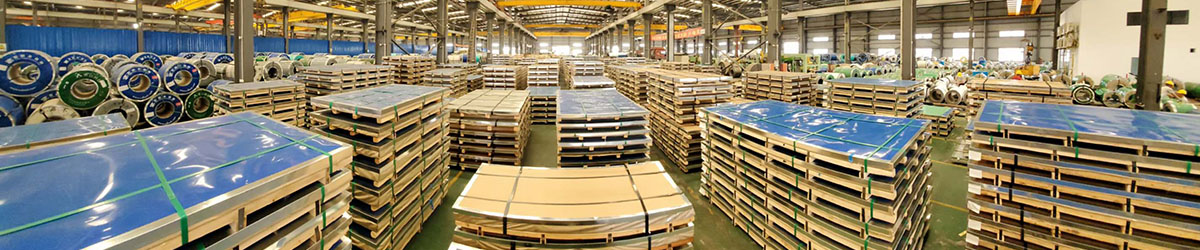
Stainless steel coil is a metallic material mainly made of stainless steel, which has excellent corrosion resistance, high strength, heat resistance and good machinability.
Production Processes of Stainless Steel Coils
1. Hot-Rolled Coil (No. 1):
*Process: Steel billets are heated and rolled at high temperature, resulting in a matte finish after pickling.
*Specifications: Thickness is typically between 3.0mm and 14mm, with some thicker options.
*Characteristics: Lower cost, but dimensional accuracy and surface finish are slightly inferior to cold-rolled coils.
*Applications: Industrial structural components, chemical equipment, pressure vessels, and other applications where surface finish requirements are not high.
2. Cold-Rolled Coil (2B/BA):
*Process: Using hot-rolled coils as raw material, further rolling at room temperature followed by annealing and pickling.
*Specifications: Thickness is typically between 0.3mm and 3.0mm, with precision strips reaching below 0.1mm.
*Characteristics: High surface finish (2B is matte, BA is mirror finish), extremely high dimensional accuracy (tolerance up to ±0.02mm), and good machinability. *Applications: The most common type, widely used in home appliances, food machinery, automotive trim, precision parts, etc.
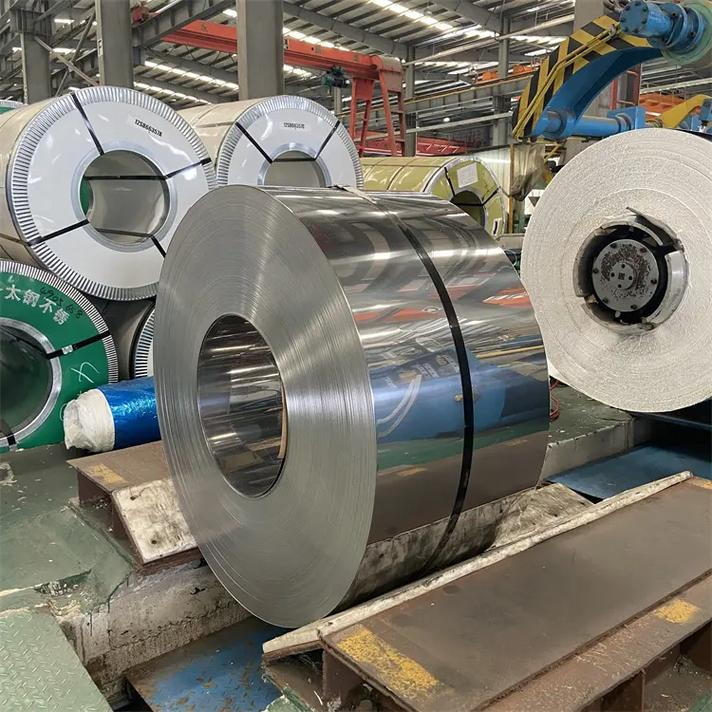
Material Classification.
Different materials determine the core performance and application scenarios of stainless steel coils.
| Material Series | Core features | Typical grades | Main application areas |
| 200 series | Low-nickel, high-manganese austenitic stainless steel reduces costs by replacing some nickel with manganese. It has relatively weak corrosion resistance and is not food-grade. | 201 | Dry environments such as building decoration, kitchenware and tableware, and auto parts. |
| 300 series | Chromium-nickel austenitic stainless steel is the most widely used series, possessing excellent corrosion resistance and processing properties. | 304、316、301、321 | Food processing equipment, chemical industry, medical industry, construction industry, home appliances, etc. |
| 400 series | Ferritic or martensitic stainless steel is magnetic and is often used in applications where corrosion resistance is not a primary concern. | 430、410 | Home appliance parts, car exhaust systems, tableware, etc. |
| duplex stainless steel | Composed of a two-phase microstructure of austenite and ferrite, it exhibits high strength and excellent resistance to chloride stress corrosion. | 2205 | Harsh environments such as chemical engineering, marine engineering, and wastewater treatment. |
Standard sizes for stainless steel coils.
| Process type | Common thickness range | Common width range | Surface condition | Typical applications |
| cold-rolled coil | 0.3mm – 3.0mm | 1000mm、1219mm、1500mm | 2B, BA, 2D, etc. | Home appliance casings, building decorations, kitchenware, precision electronics |
| hot rolled coil | 3.0mm – 16.0mm | 1000mm、1219mm、1500mm、1800mm、2000mm | NO.1 (Hot-rolled pickled) | Industrial equipment, pressure vessels, ships, structural components |
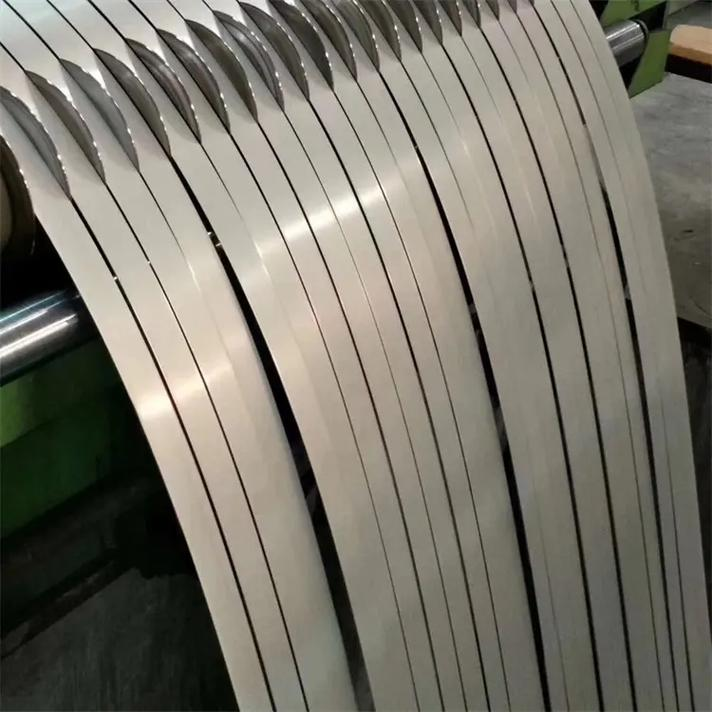
Stainless steel has a wide range of applications, from construction and automobiles to transportation and warehousing, from industrial production to home appliances, essentially covering all industries. Whether it’s stainless steel sheets, stainless steel pipes, or other forms of stainless steel materials, they can be found in various fields.
*Automotive Industry.
The application of stainless steel in the automotive industry should be considered a relatively developed area of stainless steel sheet application. Using high-strength stainless steel sheets as the raw material for vehicle body structures can significantly reduce vehicle weight and enhance the overall structural strength. If stainless steel sheets are used for vehicle panels, maintenance costs can be effectively reduced. Furthermore, due to its excellent resistance to chloride ion corrosion and heat resistance, stainless steel sheets are used in the production of automotive exhaust systems. European and American countries are using stainless steel sheets extensively as raw materials for automobile production.
*Construction Industry.
The application of stainless steel coils in the construction field has a long history and is one of the most widely used areas. In construction and home decoration, stainless steel coils are commonly used for the exterior walls and interior and exterior columns of high-rise buildings. In addition, they are used for handrails, elevator wall panels, doors, windows, and other interior and exterior components. Furthermore, surface treatments for stainless steel sheets, such as coloring and coating, can solve the problem of fingerprints easily appearing after touching, enhancing aesthetic appeal and further expanding the application areas of stainless steel coils.
*Home Appliance Business.
The consumption of stainless steel is also significant in home appliances. Just look at the inner drums of automatic washing machines, the inner tanks of water heaters, the inner shells of microwave ovens, the linings of refrigerators, etc., and it’s clear that home appliances typically use ferritic stainless steel coils as raw materials. Moreover, with the continuous expansion of the real estate market, the demand for home appliances is increasing, resulting in a surprisingly large amount of stainless steel coils.
*Industrial Facilities.
Stainless steel coils are used in chemical, petrochemical, chemical fiber, papermaking, food, pharmaceutical, and energy (nuclear power, thermal power, fuel cells) industries. With the improvement of the quality of domestically produced stainless steel coils and the development of specialized brand products, the application of stainless steel coils in domestic industrial facilities will increase year by year in the future.
Post time: Sep-02-2026


