

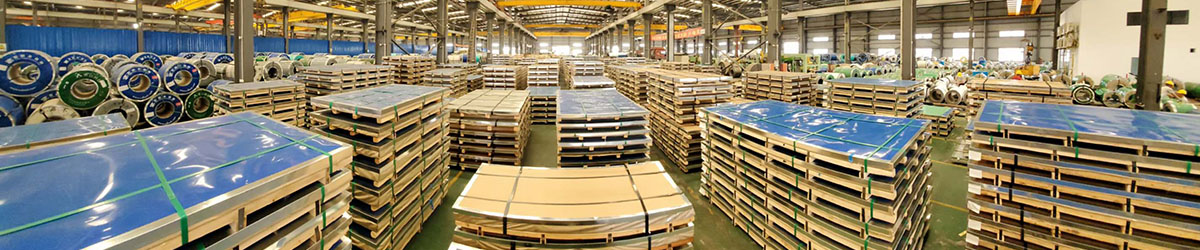
Carbon steel flat bar is a long, flat, rectangular steel bar, typically produced by hot rolling or cold drawing. Its width is much greater than its thickness, distinguishing it from square or round bars. The term “carbon steel” indicates that its primary alloying element is carbon, containing only trace amounts of other elements such as manganese, silicon, and sulfur. The carbon content (from as low as 0.05% to over 1.0%) directly affects the hardness, strength, ductility, and weldability of the steel bar.
Cold rolling is rolling performed below the recrystallization temperature. It is usually carried out at room temperature, although sometimes the steel is slightly heated to reduce processing difficulty, but the temperature is much lower than the hot rolling temperature.
Cold rolling is generally performed on hot-rolled steel. After surface treatments such as pickling, the hot-rolled steel is fed into a cold rolling mill for further rolling. During cold rolling, the steel is further reduced in thickness and its dimensional accuracy and surface quality are improved by the squeezing action of the rolls at room temperature. Because cold rolling is performed at lower temperatures, the work hardening of the steel is more pronounced, requiring intermediate annealing and other treatments to restore its plasticity. After work hardening, cold-rolled steel exhibits significantly increased strength, but its plasticity and toughness decrease somewhat. Cold-rolled steel offers higher surface quality and more accurate dimensional precision, making it suitable for applications requiring high surface quality and dimensional accuracy.
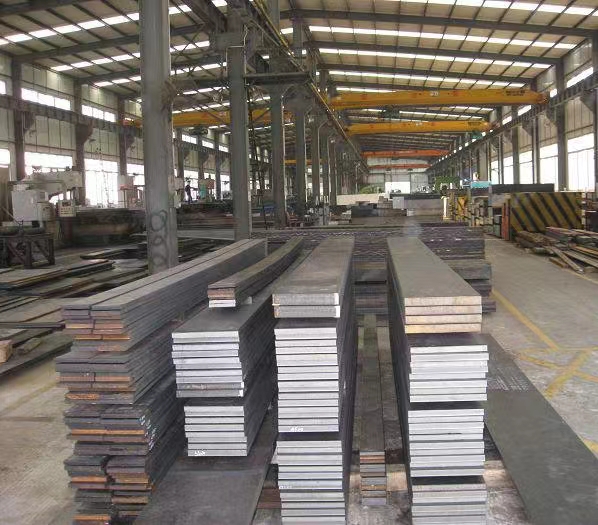
Hot rolling is a rolling process performed above the recrystallization temperature. The vast majority of carbon steel flat bars are produced using hot rolling. The heating temperature is generally around 1100℃ to 1250℃, at which point the steel is in a high-temperature softened state, making it easy to plastically deform. These are economical, available in a wide range of sizes, typically from 1/8 inch to 4 inches in thickness and up to 12 inches in width.
First, the steel billet is heated to a high temperature, then rolled multiple times through a series of rolls, gradually reducing the thickness of the steel while adjusting its shape and dimensions. During hot rolling, the microstructure of the steel changes; the original cast structure is transformed into a directional hot-rolled structure through rolling and cooling. Hot-rolled steel typically has a rougher surface and may have deposits such as iron oxide scale. Hot-rolled steel has relatively lower strength but better plasticity and toughness. This is because the steel undergoes high-temperature heating and rapid cooling during hot rolling, resulting in a more uniform microstructure and lower internal stress.
The mechanical properties of carbon steel flat bars depend on their carbon content and heat treatment process. Typical low-carbon steel (AISI 1018, ASTM A36) flat bars have a tensile strength of approximately 400–550 MPa, a yield strength of approximately 250–350 MPa, and an elongation at break of 20–25%. They are soft, ductile, and easy to weld or machine. Medium-carbon steel (AISI 1045), after normalizing, can achieve a tensile strength of 570–700 MPa, but its weldability decreases. High-carbon steel (AISI 1095) can have a tensile strength exceeding 800 MPa, but is brittle unless heat-treated.
Besides carbon, other elements also play subtle roles. Manganese (up to 1.65%) increases strength and removes oxides from the steel. Phosphorus and sulfur content are kept low (both below 0.05%) to prevent cold brittleness and hot cracking. Some flat steel undergoes a pickling and oiling process to remove rolling scale and provide temporary rust protection.
One of the main application areas for carbon steel flat steel is the construction industry. These flat steels are often used as structural components in buildings, bridges, and other infrastructure projects. Their strength and stiffness make them ideal for supporting heavy loads and providing stability for a variety of structures. Furthermore, carbon steel flat steel is frequently used to manufacture frames, supports, and brackets; its flat shape facilitates integration into various designs. The versatility of flat steel products makes them a preferred choice for engineers and architects.
Besides the construction industry, carbon steel flat steel also has extensive applications in the automotive and machinery industries. They are commonly used in the production of various automotive parts, such as chassis, axles, and suspension systems. The high strength-to-weight ratio of carbon steel flat steel allows manufacturers to create lightweight yet robust components, thereby improving vehicle performance and fuel efficiency. Furthermore, in the machinery industry, flat steel products are used to manufacture equipment and tools, and their durability and wear resistance are crucial for long-term performance.
Choosing the right carbon steel flat bar requires balancing several factors: required mechanical properties (strength, ductility, hardness), dimensional accuracy, surface finish, corrosive environments, processing methods (welding, machining, bending), and budget constraints. For most general structural applications, ASTM A36 hot-rolled low-carbon steel flat bar offers the best combination in terms of availability, machinability, and cost. For precision shafts or machine tool guideways, cold-drawn 1018 or 1045 steel is a better choice. For highly worn parts such as scrapers, high-carbon steel or heat-treated flat bar may be required.
Post time: May-18-2026


