

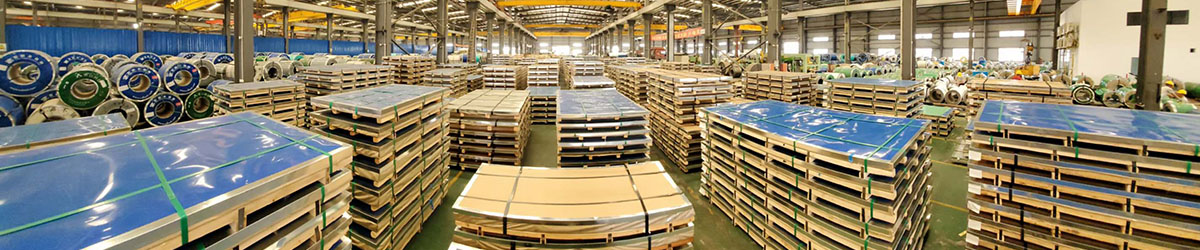
Stainless steel sheets have a smooth surface, high plasticity, toughness, and mechanical strength, and are resistant to corrosion from acidic and alkaline gases, solutions, and other media. It is an alloy steel that does not easily rust, but it is not absolutely rust-proof. Stainless steel sheets refer to steel sheets resistant to corrosion from weak media such as atmosphere, steam, and water, while acid-resistant steel sheets refer to steel sheets resistant to corrosion from chemically corrosive media such as acids, alkalis, and salts.
Stainless steel sheets come in various grades, with the most commercially important series including austenitic, ferritic, duplex, and martensitic. Each grade has unique mechanical properties and corrosion resistance, making it suitable for specific applications.
Austenitic Stainless Steel (300 Series)
304/304L: General-purpose stainless steel. It has good corrosion resistance, formability, and weldability.
316/316L: With the addition of 2-3% molybdenum, it has excellent resistance to chlorides (seawater, de-icing salt).
321: With the addition of titanium stabilizers, it prevents sensitization during welding.
310S: High-temperature grade (up to 1100°C), suitable for furnace components.
Ferritic Stainless Steel (400 series, e.g., 430, 409, 439) Ferritic stainless steel sheets contain 10.5%–27% chromium, extremely low carbon content (<0.1%), and very little or no nickel. They are magnetic and have good resistance to stress corrosion cracking, but their formability and toughness are inferior to austenitic stainless steel. They cannot be strengthened by heat treatment. Typical applications: automotive exhaust systems, building panels, and interior electrical appliances. In mild environments, grade 430 is a common low-cost alternative to grade 304.
Duplex Stainless Steel (e.g., 2205, 2507) Duplex stainless steel has a microstructure consisting of a mixture of austenitic and ferritic materials (approximately 50/50). Due to its high chromium content (21-26%), moderate nickel content (4-7%), and molybdenum content (0-4%), 2205 stainless steel has a yield strength approximately twice that of austenitic stainless steel, while maintaining excellent resistance to chloride stress corrosion cracking. 2205 stainless steel is widely used in chemical tankers, seawater desalination, and pulp digesters. Its higher strength allows for the use of thinner sheets, thus reducing weight and cost.
Martensitic stainless steel (e.g., 410, 420) contains 11-17% chromium and a higher carbon content (0.1-1.2%), thus allowing for hardening through heat treatment. They are magnetic, strong, and wear-resistant, but their corrosion resistance is lower than that of austenitic or duplex stainless steels.
The main difference between 304 and 316 stainless steel plates: 304 stainless steel, which we encounter most daily, is the benchmark for food-grade stainless steel and also the king of cost-effectiveness in household applications. It boasts excellent corrosion resistance, rust prevention, and high-temperature resistance. For insulated cups, tableware, kitchen sinks, food processing equipment, and bathroom hardware, 304 is the perfect choice. It’s safe, non-toxic, and rust-resistant for everyday use, suitable for most home scenarios, and offers exceptional durability.
316 stainless steel, on the other hand, is a medical-grade/high-end industrial-grade material. It adds molybdenum to 304, significantly improving its corrosion resistance, acid and alkali resistance, and making it more resistant to high temperatures and seawater corrosion. It’s widely used in high-end kitchenware, medical devices, chemical pipelines, and outdoor coastal facilities. While not essential for everyday household use, 316 is the optimal solution for applications requiring high corrosion resistance.
Another significant difference lies in cost; due to its higher nickel and molybdenum content, 316 stainless steel is typically more expensive than 304 stainless steel. Therefore, the choice between these two steels usually depends on specific application requirements, including budget constraints and environmental factors.
Stainless steel is an extremely versatile engineering material, especially the 304 and 316 grades, which play a crucial role in various industries due to their unique properties and applications. Whether in food processing, construction, automotive, medical, chemical, or energy industries, stainless steel sheets have always been a reliable choice for engineers and manufacturers. As industries continue to evolve and the demand for durable, corrosion-resistant materials continues to grow, the importance of stainless steel sheets will only increase.
If you need to purchase stainless steel sheet products, please click to contact us for consultation. Jindalai Steel Group Co., Ltd. will provide you with the most professional answers.
Post time: May-11-2026


